

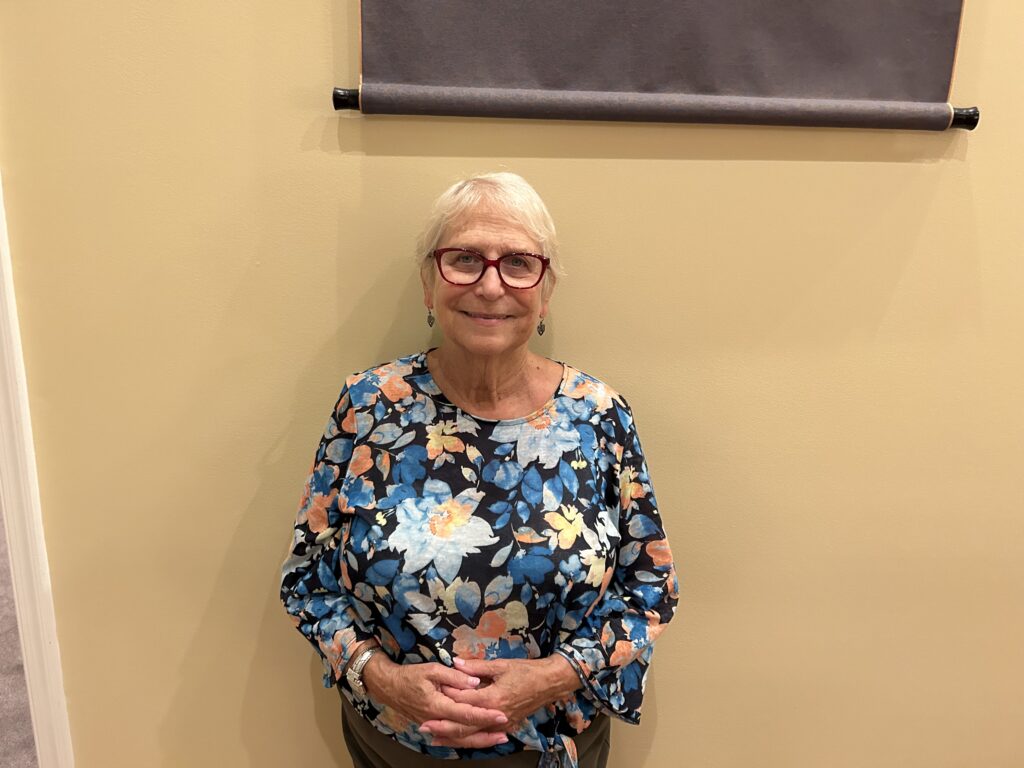
Meryle Melnicoff served on the Friendship Bridge Board of Directors for a decade.
When Meryle Melnicoff first learned about Friendship Bridge back in 2012, she could not have imagined how near and dear to her heart the organization—and the countless individuals she met through her involvement—would become. When her nine years of service as a Board Member at Friendship Bridge came to an end in 2024, she knew she wanted to continue supporting the organization which she had come to know and admire so deeply.
She has done so by becoming involved with a Friendship Circle, a group of volunteers who support Friendship Bridge’s mission by hosting social gatherings, organizing fundraising efforts, and raising awareness in their local communities. She learned about the Global Satellite Circle, an online group of individuals living in different cities who all support Friendship Bridge, and officially joined the group.
“It’s a wonderful way for me to stay engaged,” said Meryle. “I’m starting to get to know the Circle members, and they are really amazing. One thing that’s so interesting about our Circle is that everyone is coming to Friendship Bridge from a different perspective, so we are expanding each other’s horizons.”
Read on to learn more about Meryle’s expertise, contributions, and why she remains committed to supporting Friendship Bridge as she transitions to a new sphere of involvement.
Meryle’s path to the Friendship Bridge Board of Directors
Meryle’s professional background in the biomedical industry, together with her lifelong commitment to further women’s empowerment both locally and globally, made her an ideal candidate to join Friendship Bridge’s Board of Directors. Meryle co-founded the Alliance of Women Entrepreneurs of Philadelphia and published two guidebooks on funding for start-up businesses. Prior to her retirement, Meryle was the Director of Business Development at a nonprofit medical research institute in Philadelphia, where she established collaborations that led to the commercial development of technologies for new vaccines and cancer treatments.
Meryle was introduced to Friendship Bridge by a group called WIL: Women for International Leaders, a diverse group of professional women in the Philadelphia area who share a passion for women’s empowerment and making a difference in people’s lives. WIL provides funding, typically in the form of block grants for microloans and other projects, to partner organizations in 16+ countries—including Friendship Bridge in Guatemala.
When Meryle learned that Friendship Bridge hosted Insight Trips—week-long experiences to Guatemala to learn about Friendship Bridge’s impact—she was eager to go. In 2013, without knowing anyone in the group, she made the trip to Guatemala.
The group was welcoming and the experiences were eye-opening. During the Insight Trip, she met several Board members, as well as current Chief Strategy Officer Caitlin Scott. Meryle’s expertise working with both nonprofit and for-profit organizations, combined with her passion for women entrepreneurs, made her an attractive potential board member. Shortly after the Insight Trip, Meryle was invited to Colorado (home of Friendship Bridge’s U.S. headquarters) to learn more about the organization. She officially joined the Board in 2014.

Meryle Melnicoff (center, front) visits Friendship Bridge clients along with other members of the Board of Directors.
How Friendship Bridge differs from other microfinance organizations
From the start, Meryle was impressed by the way Friendship Bridge embodies its values: empowerment, respect, solidarity, participation, quality, integrity, transparency. These values manifest themselves in the organization’s business model.
“What I think is very special about Friendship Bridge is how the loans are always paired with education,” Meryle said.
For example, clients are expected, as a condition of their loan terms, to attend Non-Formal Education sessions. These sessions, held monthly during clients’ loan repayment meetings, offer clients skills and knowledge on topics such as savings, healthy eating, women’s rights, and more.
She remembers conversations with investors at a microfinance conference that she attended shortly after joining the Board. While they and other finance-driven lenders were boasting about high rates of return to investors, Meryle once again felt grateful to be a part of an organization that lived by its mission and led by example.
“Many microfinance organizations are profit-driven so revenues from the microloans benefit their investors,” she explained. “However, Friendship Bridge and other well-run nonprofit organizations use this revenue to provide critical services to clients.”
These critical services are part of what Friendship Bridge calls Microcredit Plus: an innovative and high-impact approach to poverty alleviation that combines the tools of microfinance, education, and preventive health services.
This commitment—to empower women so that they may participate in decisions about their health, their income, and their conditions at home—is recognized and valued by those whose voices matter the most: the clients themselves. Clients consider that Friendship Bridge has significantly contributed to their improved quality of life (97%), their ability to make financial decisions (93%), and their increased income (93%) among other outcomes, earning Friendship Bridge the recognition as a Top Microfinance Organization in Latin America.
“So many groups say, ‘We want to do good. We’re going to go build a school. We’re going to go do this.’ But very few organizations take the time to track, ‘Are we really improving the lives of the people?’ Today donors are often also impact investors, so they want to see how their investments are improving the lives of clients and their families,” Meryle explained.
Learning about social performance measurement
Meryle has learned a lot about social performance measurement—throughout her Board tenure, she served on the Education and Social Performance Committee (ESPC) and was chair of the committee for nearly six years. She feels fortunate for having been able to witness the initiatives Friendship Bridge has incorporated into its services.
Right around the time when she joined the Board, Friendship Bridge was in the initial phases of developing a health program, now known as Health for Life. This program, in partnership with Wuqu’ Kawoq (Maya Health Alliance), provides health education and culturally-sensitive medical services to Friendship Bridge clients.
“I thought Friendship Bridge did really well strategically by partnering with the Maya Health Alliance,” Meryle said. “Visiting the client in her own place, that’s culturally sensitive, but it’s also acknowledging that our clients often don’t get healthcare because they cannot travel to the cities where clinics are located. Another big barrier is language —and the [Maya Health Alliance] nurses are fluent in the indigenous languages which the Friendship Bridge clients speak.”
Meryle and the ESPC also saw Friendship Bridge implement the Poverty Stoplight to track clients’ progress, following the poverty elimination methodology of Fundación Paraguaya. The Stoplight consists of 31 indicators organized into six different dimensions: Income and Employment, Health and Environment, Housing and Infrastructure, Education and Culture, Self-reflection and Motivation, and Organization and Participation. The tool is designed to help clients holistically assess their living conditions and quality of life in order to identify concrete actions for improvement. The methodology fits in well with Friendship Bridge’s commitment to regularly evaluating progress against social objectives and continuously learning how to improve.
One of the results of the first Poverty Stoplight survey was that clients wanted to improve their waste management practices. “This was the first surprise for me,” Meryle remembered. “Our clients wanted help getting rid of their trash in a healthier way.”
Friendship Bridge responded to this need. “In response, the Social Performance Task Force has now put environmental performance as one of their key indicators,” Meryle explained. “Friendship Bridge is now much more environmentally sensitive because this need is coming from the clients, and this is also important to the organizations who are giving us our standards. It’s not enough to be women-oriented; you also need to have an environmental plan.”
A client-centric approach to program development
Meryle notes how Friendship Bridge’s resolve to be client-centric is evident across their operations, and especially in their thoughtful approach to program development.
“What they’ve always done [with new Friendship Bridge programs] is a pilot. And then they carefully evaluate the results of the pilot before moving on. To me, that’s another side of Friendship Bridge that distinguishes it from many other organizations; they put a huge effort into tracking whether the services that our clients are getting are really helping them and improving their lives.”
The organization’s commitment not only to get it right, but to truly make a meaningful difference in the lives of the women, their families, and their community members still impresses Meryle every time she reads an update.
“Friendship Bridge, by themselves as well as by working with various partners, puts a lot of effort into really making sure we are helping our clients the way we think we are,” Meryle continued. “Now we’re starting to have an impact on the next generation. We’ve always tracked things such as, ‘How many of your children go to school? How many get a secondary education?’ And now we’re seeing that not only are the women themselves becoming more independent and having more of a voice in the family, but it’s impacting their children, too. That’s amazing to see.”
About the author: Kaylin Lang is a member of Friendship Bridge’s Global Satellite Circle; she also worked with Friendship Bridge in the past, first as a Training and Sales Intern for the Artisan Market Access Program (now Handmade by Friendship Bridge®) and later as a Content Associate. Kaylin is passionate about Friendship Bridge’s work and values the opportunity the highlight the organization’s growing impact through storytelling.
————–
Are you a Friendship Bridge Circle member or volunteer, who has a story to share on our blog? Please see our Submission Guidelines.


